
RapidSAP
We provide enterprise cloud solution via RapidRISE, RapidGROW and RapidMOVE.



RapidRISE, which utilizes the Greenfield approach (new implementation/ re-implementation), involves implementing the new system for larger enterprises from scratch without carrying over any existing configurations, customizations, or historical data from previous SAP systems/legacy systems. It’s essentially starting with a clean slate, allowing organizations to design and build the new system based on S/4HANA’s capabilities and best practices without being tied to legacy structures or processes.
Benefits include:
01
Holistic Transformation
Transform your business with best-in-class business processes.
02
Standardization and Best Practices
Allows organizations to adhere to standard SAP processes and best practices.
03
Clean Slate for Optimization
Starting afresh with a Greenfield approach allows businesses to optimize their processes without the limitations of legacy systems.
04
Leverage the broader technology ecosystem effectively to maximize capabilities
05
Measure, monitor and optimize business processes to ensure continuous business performance improvement
06
Ensure a predictable total cost of technology ownership
07
Drive security, compliance, and scalability
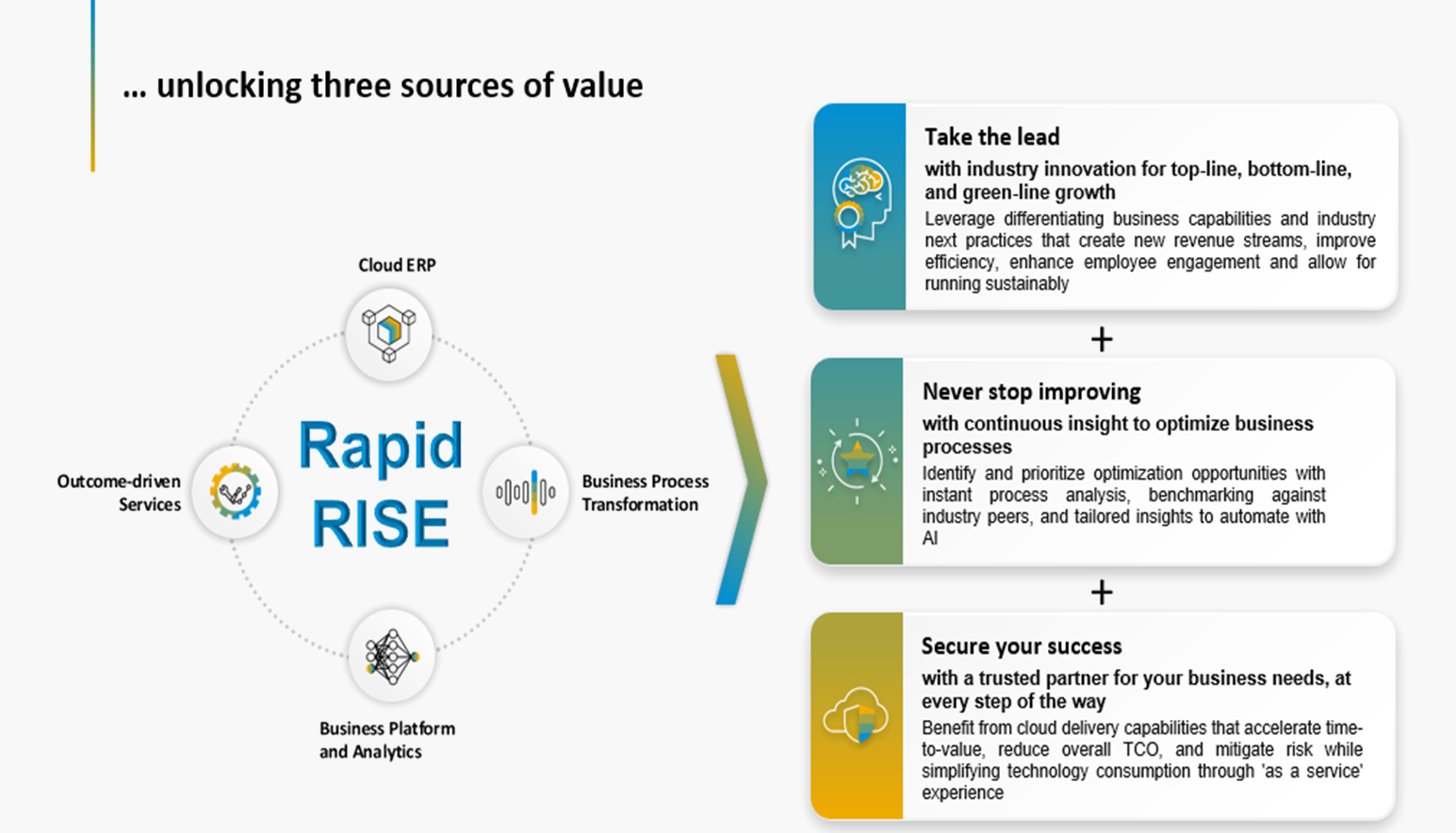
Why SAP Customers Choose RapidRISE?
RapidGROW
RapidGROW, which is the new implementation approach, enables small and midsize businesses to adopt cloud ERP capabilities that scale as their needs change along every stage of their growth. Using this offering, organisations can embrace SAP S/4HANA Cloud, public edition, where the infrastructure and software capabilities of SAP S/4HANA Cloud are shared with other SAP customers and are hosted and operated directly by SAP.
Benefits include:
01
Faster, simplified adoption of advanced cloud ERP
02
Greater scalability to grow the solution
03
Enhanced efficiency through optimized processes
04
Increased predictability of costs and operations
05
Community support and role-specific learning

Solution Components
SAP S/4 HANA Cloud, public edition
Grow without limits and build your own breakthroughs with a ready-to-run cloud ERP.
SAP Business Technology Platform (Build)
Build, integrate and collaborate with an agile innovation platform.
Industry best practice content
Run with industry best practices by applying pre-configured processes that are ready-to-go.
Adoption and Acceleration Services
Tools and Methodologies
Expedite rollout of Cloud ERP with proven SAP Activate tools and methodology.
Packaged Activation Services
Avoid surprises with a predictable scope and timeframe delivered through a proven deployment service.
Trusted partner
E-Outsource Asia help customers to get quick time to value based on the fit to standard approach.

Learn More
Grow with SAP Explained in 3 Level of Difficulty
RapidMOVE
RapidMOVE, which utilizes the Brownfield approach, is a technical in-place conversion of an existing SAP ECC System to SAP S/4HANA, rather than starting from scratch.
Benefits include:
01
Faster Implementation
Leveraging existing structures and configurations speeds up the migration process compared to starting from scratch.
02
Simplify Change Management
Existing user familiarity facilitates smoother adoption, fostering higher levels of user acceptance and reducing the overall training requirements.
03
Cost-Efficiency
By reusing existing components and configurations, organizations save on costs associated with rebuilding or redesigning systems from scratch.
04
Reduced Disruption
Brownfield migration minimizes business disruption by enabling a smoother transition.